
Robert Reed Church Sr. and His Home
By Dennis Wolf
Robert Reed Church Sr. 
Robert Church Sr. was born on June 18, 1839. Church was a formerly enslaved Memphian who became a leading real-estate investor, entrepreneur, Republican political figure, and philanthropist. In 1899, Church bought land east of Beale and Fourth and built a park and a 2,200-seat auditorium, the first of its kind, for African Americans. He was also a saloon owner and a banker. In 1906, he founded the all-black-owned Solvent Savings Bank and Trust Company at 386 Beale Street (the building is still there), enabling African-Americans to purchase homes and start businesses. Church is considered the South’s first black millionaire.
His primary business was real estate. The 1878 yellow fever epidemic devastated Memphis and the city lost its charter. Many Memphians left the city, businesses failed, and property was abandoned, contributing to depressed land values. Church bought property during and following the epidemic, a contributing factor to his business success.
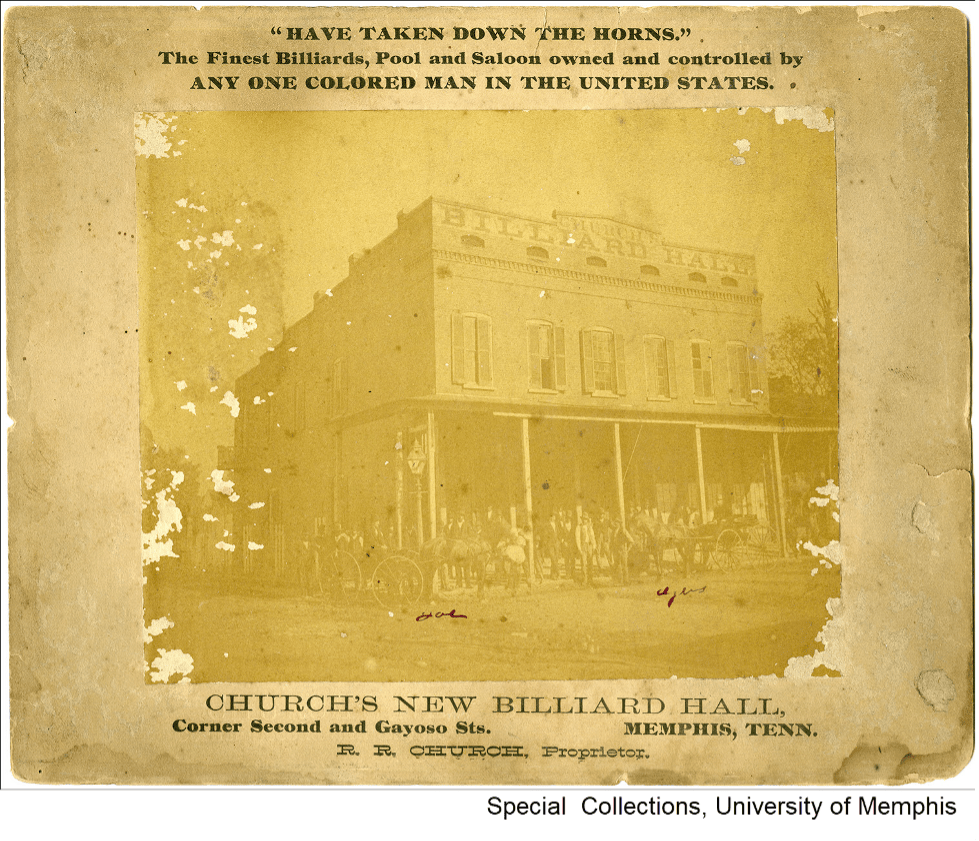
Memphis lost its charter in 1879 due to significant financial loses and was classified as a taxing district. Church’s businesses and land holdings helped the city recover financially. In 1893, Memphis petitioned the state to restore its charter. To get its charter back, Memphis needed to sell municipal bonds to raise money, as the state would no longer be providing tax revenue. For $1,000 ($37,102 in 2026 dollars), Church bought municipal bond number 1, making him a founder of the new City of Memphis.
The Church Home
Church Sr. designed and built his home at 363 Lauderdale circa 1884. In 1905, Memphis renumbered its streets and the address was changed to 384 South Lauderdale Street. The area was a thriving, well-maintained, and racially-integrated neighborhood.
Described in various sources as “lavish” and “magnificent,” the home was three-stories tall with a cellar, of frame construction, and built in the Queen Anne style. It had 14 or 18 rooms (depending on the source), four bay windows, an elaborate 32-foot by 16-foot drawing room, a parlor, and interior mural and fresco work by an Italian artist. It was considered one of the very first prominent Queen Anne homes built in Memphis. The home sat on two acres of land and included dedicated servant quarters and stable grounds. According to Elaine Turner of Heritage Tours, the home was so spectacular that it was described in the daily white newspapers, something very unusual for the time.
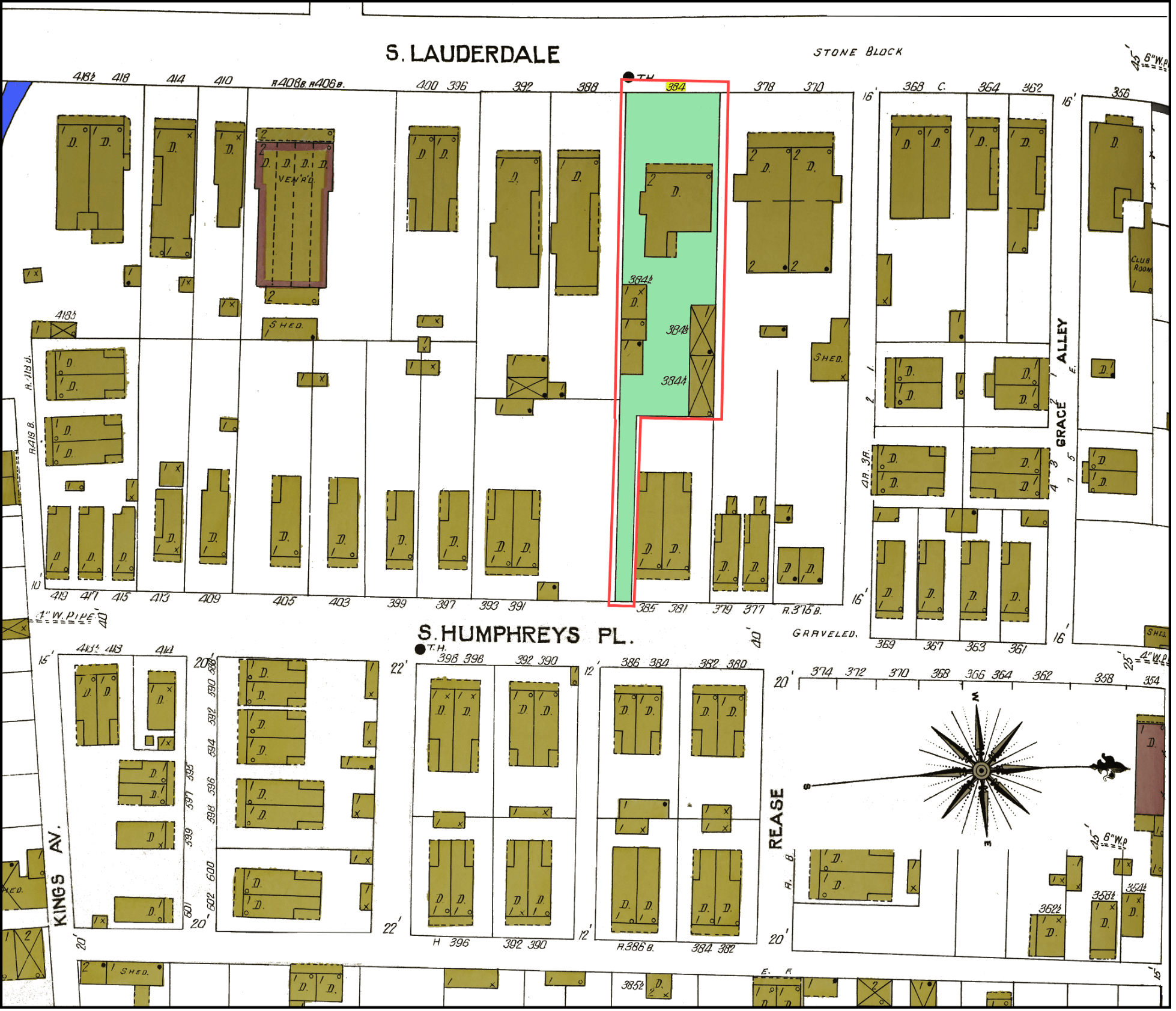
The location of the Robert Church home – Sanborn Fire Insurance Map 1907
The home, described in The Planters Journal as “the finest and most modern dwelling owned by a colored man in this country,” was the social hub for prominent black Memphians. Frederick Douglass and Booker T. Washington visited the home. President Theodore Roosevelt visited the home when he came to Memphis in 1902. At the turn of the twentieth century, the area was integrated and prosperous, and the Church mansion was the crown jewel of the area. When Church Sr. died the house passed to his son, Church Jr. Church Jr. and other family members continued living in the home until 1941.

Courtesy Middle Tennessee State University
The photo above was exhibited at the Paris Exposition of 1900 and captioned “Negro Homes–home of R.R. Church, Memphis, Tenn. (exterior).” Prominent sociologist W.E.B. Du Bois and Thomas J. Calloway selected it for the American Negro Exhibit at the Paris Exposition of 1900 as a testament to the educational, economic, and cultural progress of African Americans.
Enter “Boss” Crump
Unlike many southern cities, Memphis, under “Boss” Crump, encouraged blacks to vote, as long as they voted the way Crump wanted. Church Jr. helped organize the significant bloc of black voters to align with the Crump political machine. As part of the favors given to his allies, Crump allowed Church Jr. to forgo paying property taxes on the properties he owned. Church Jr. and Crump had a falling out when Church refused to support Walter Chandler, Crump’s pick for the state’s governor’s race. The rift deepened in 1940 when Church campaigned for Wendell Wilkie, the Republican presidential candidate. Crump took his revenge, and his administration seized 11 of Church Jr.’s real-estate holdings, including his home, on alleged tax delinquency. The seized property was sold at auction on February 10, 1940 for $83,000 ($1,979,657 in 2026 dollars).
Church Jr. moved to Washington, DC, but other family members used the home for a decade. David William resided there from 1943-1946. Ella Dotson lived there from 1948-1950. The house then sat vacant for 2 years.
There is some debate over whether Crump’s final act of revenge was having Chruch’s former home used for fire department training. Even though Crump’s political career ended in 1948, a few sources say that Crump still had local political influence up until his death in 1954. Some allege that Crump picked the property for use during a national fire conference. Memphis hosted the Fire Department Instructors Conference, and the latest firefighting equipment and techniques were displayed and demonstrated. To do this, the fire department needed buildings to burn. Under the pretext of urban renewal, the area needed to be cleared to make way for public housing. Church’s former home was one of the 19 homes selected for the demonstration, and the fire department set fire to it for training on Thursday, February 26, 1953.

The training fire on the afternoon of February 26, 1953. The home on the left in the photo is the former Robert R. Church Sr home. The photographer is unknown. Photo courtesy of Adelman’s History of the Memphis Fire Department Facebook page.
The majority of sources consulted label this claim of retribution as a myth, and no primary sources could be found confirming that Crump ordered the destruction of the home. Robert Church had also not lived in the home for 12 years when it was selected for firefighter training. What is not contested is that the Crump political machine unquestionably contributed to the financial ruin that caused Church Jr. to lose his real-estate holdings, the selling of the property for back taxes, and the house’s ultimate fall into disrepair.
In 1955, the City of Memphis opened the Cleaborn Homes public housing development, which included the former location of the Church home. The project consisted of 572-units sitting on 27 acres along South Lauderdale Street near Vance Avenue. Built during the Jim Crow era, Cleaborn Homes was a segregated housing development for African-American families. Cleaborn Homes was torn down in 2011 and replaced with a mixed-income community called Cleaborn Pointe at Heritage Landing, which opened in 2015.
Sources
Adelman’s History of the Memphis Fire Department Facebook page
Beale Street Dynasty by Leonard Gill
History through Homes website
Memphis In Black and White, Beverly G. Bond and Janann Sherman
Memphis: 200 Years Together, edited by Karen Golightly and Johnathan Judaken
Sanford School of Public Policy, Duke University
Special Collections, University of Memphis
The Burning of the Robert Church Jr. Home by Joe Lowry, Our Memphis History
The Chicago Defender, January 4, 1941
The Commercial Appeal, February 26, 1953
The Commercial Appeal, October 1, 1992